
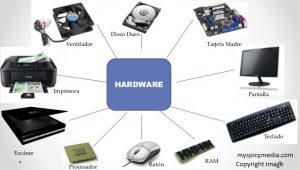
Hardware:
The term “Hardware” refers to the physical elements of a computer; the machinery or the electronics in a computer. A basic computer consists of 4 components:
- Input device (or input unit)
- CPU (Central Processing Unit)
- Memory (or Memory unit)
- Output device (Output unit)
Input unit and Output unit:
Input unit sends (data) to the computer and output unit presents (information). Input unit: keyboard, mouse, flash drive, etc. Output unit: monitor, printer, speaker, etc.
Input and output unit or Input and output device (I/O) provide a way to interact with a computer. Some examples of I/O devices are: keyboard used to input text, mouse, touch pad, camera, monitor, speakers, touchscreen for simultaneous input and output.
Examples of hardware (I/O) in a computer are:
- Keyboard
- monitor
- Speaker
Most of a computer’s hardware cannot be seen as it is inside the computer case. Example: Memory, CPU, etc.
Memory Unit
The memory unit is what allows a computer to remember data and information. Similar to human memory, there is short term memory (RAM) and long term memory (Hard Disk Drive (HDD), Solid-State Drive (SSD) or Compact Disk Drive (CDD)).
Examples of hardware (Memory) in a computer are:
- RAM
- Hard disk drive
- Compact disk drive
- Solid state drive
When a computer is turned off, it forgets everything in the RAM (short term memory), while it saves everything it will need later into a disk drive (long term memory). When data is needed by the CPU, it’s sent from the hard disk drive (HDD) or compact disk drive (CDD) to the RAM. RAM tends to be faster to process, whereas HDD/CDD have more data and require longer to process. CDDs let you change certain parts of the memory, essentially like a book or notebook that you might read and get information from.
- A storage medium gives your computer a place to store data and information that it might need in order to operate. Some things that could be stored in memory might be: text documents, photos, programs, and the operating system (OS).
CPU:
The CPU(or Central Processing Unit) performs arithmetical and logical operations of the computer system.
The central processing unit, or processor, is the component of a computer that performs processes. Examples of other tasks performed by the CPU include:
Input/Output directions (reading data from an input device/writing information to an output device) The central processing unit, or processor, is the component of a computer that performs processes. Examples of other tasks performed by the CPU include:
Motherboard:
The motherboard is hardware that makes connections between all of the other components in a computer, effectively telling data where it should go.
Expansion card:
The expansion cards are electronic circuits that add specific ability to a computer system
EXAMPLES:
- Graphic card
- Sound card
- Expansion card
Power supply:
A power supply (power supply unit) is a device that provides electrical energy to the computer system.
Assembled Personal Computer Hardware:
The hardware as assembled with a typical personal computer include
- Monitor
- Motherboard
- CPU (Microprocessor)
- Main memory (RAM)
- Expansion cards
- Power supply unit
- Compact disk drive (CDD)
- Hard disk drive (HDD) or secondary compact disk drive (CDD)
- Keyboard
- Mouse